


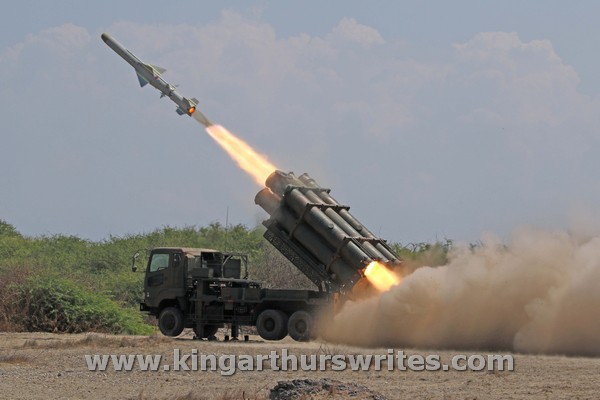
The JGSDF launched two Type 88 anti-ship missiles from Laoag in northern Luzon during Exercise Balikatan 2026.
Updated 23 August 2026
Exercise Balikatan 2026
Involving 17,000+ troops from seven countries, the largest ever Balikatan multilateral exercise took place in the Philippines from 20 April till 8 May 2026. This was the 41st iteration of these annual wargames. King Arthur’s Writes attended various activities in locations such as Palawan, Zambales, Laoag and Batanes Islands. The Tagalog word Balikatan means “shoulder to shoulder”, and General Romeo Brawner Jr., then Chief of the Armed Forces of the Philippines, said the exercise’s “real value is showcasing our resolve to work together to defend the Philippine archipelago and to uphold the rules-based international order. That’s the more important aspect of all the exercises we’re doing here.”
The unspoken threat is China, as it encroaches on the Philippine exclusive economic zone in the West Philippine Sea/South China Sea. Simultaneously, Beijing is aggressively bullying and harassing Philippine fishermen, as well as military and coast guard forces. Beyond that, the spectre of Chinese aggression against Taiwan looms. Balikatan 2026 thus highlighted how the Philippines and USA – along with allies Australia, Canada, France, Japan and New Zealand – are rehearsing how to seal off the so-called First Island Chain that stretches from southern Japan down through Taiwan to the Philippines and Indonesia.
Asked about the exercise series, General Ron Clark, Commander of United States Army Pacific, told King Arthur’s Writes: “In the big scheme of things, our highest duty is to deter. For those of us that have served in conflict and served in combat, that’s really what it’s about – deterring war. The best way to do that is to be ready.” That was the ultimate purpose of Exercise Balikatan 2026, to deter China.
